
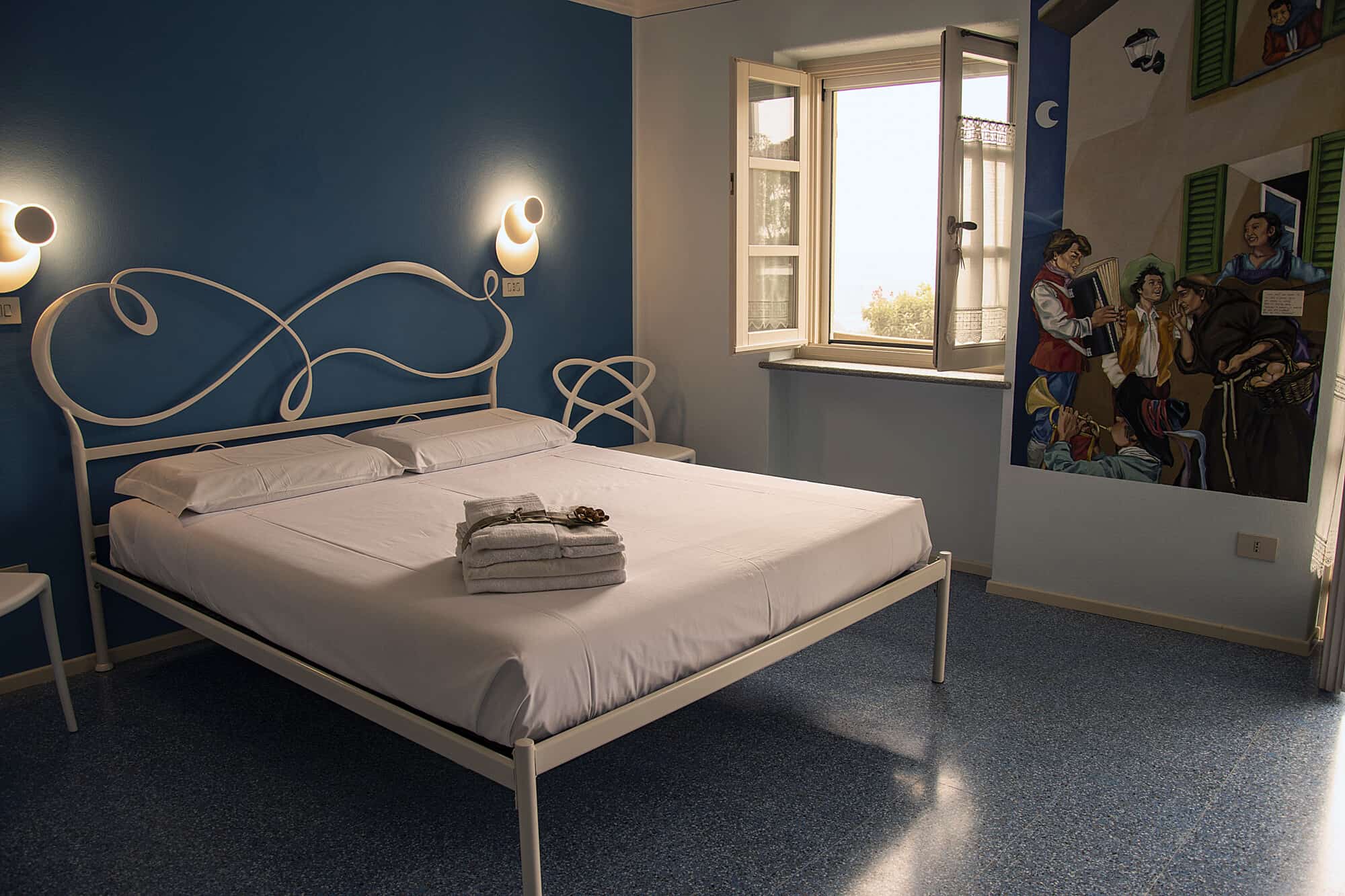
Late at night, from courtyard to courtyard with a folk song on their lips and the friar’s woven basket in their hand.
The room
 2 adults + 1 child or 3 adults Double bed En-suite bathroom with shower Km0 breakfast included Air conditioning First floor Shared balcony Free Wi-Fi
Underfloor heating. Electric kettle and herbal teas provided. Hairdryer. Smart TV. Window screen.
Available on request: extra bed or travel cot and bed guard rail for small children.


The room Cantè j’ov nel Roero has a double bed length 190 x 160 width. From the balcony shared with the studio apartment “le Masche”, the view stretches from the Langhe and Roero hills to the Alps and the Monviso.
Cantè j’ov
The Egg Quest
During the Holy week, groups of young men would go from courtyard to courtyard in the evenings, playing instruments and singing for eggs. If the owners of the farms fulfilled their demands, the young men would sing propitiatory chants, otherwise they would receive scornful curses.
The Canté j’öv (the Egg Quest), was a ceremony held during Holy Week by exclusively male groups, mostly consisting of young men. It was carried out in the evening and lasted until late into the night, and it followed a musical and dramatic script that was repeated from courtyard to courtyard.
After arriving in front of each house, the questors would perform a multi-stanza song accompanied by musical instruments such as the clarinet, the accordion, the genis and the drum. The song verses could vary from village to village, but the structure was the same: an introductory preamble, a deferential homage to the inhabitants of the house and then an apology for the disturbance and the late hour; after that, they would sing their requests for the eggs, and finally the farewell, which would take different forms depending on the outcome of the quest.
If the questing had been good and the bounty was plentiful, they would give their thanks to the hosts and promise their return the following year; if it had been unsuccessful, mockery and curses would fall upon the stingy house, its inhabitants and their hens (“May this house be hit by drought, may your cockrel’s crest die and your hens’ ass go dry and sterile”). The collected eggs (but also the salami and wine most generous hosts would provide) were then cooked and consumed by the group on Easter Monday.
The Canté j’öv tradition stems from the pagan ceremonies celebrated in pre-Christian times, which were linked to seasonal changes and agricultural fertility cults. The gift of the egg, a symbol of fertility, is the salient element of this ancient ritual, which was widespread and is still somewhat known throughout Europe (as can be noted still today in the chocolate Easter egg). Another curious aspect of this practice was the presence of the “fratucin” (the friar), a young man dressed in a crude sackcloth tunic whose job it was to hold the basket for the eggs. In these cases, the chant often featured irreverent digressions that hinted at the “friar’s” lecherous intentions towards the marriageable girls present in the house.
In addition to the entertainment aspect, an interesting facet of this tradition is the use young men made of it. If the girl of the house, upon hearing the singing voices of the questing party, came down with family members to give eggs, it was regarded as acceptance of the romantic overtures that one young questor in the group had made previously. In fact, in addition to the request for eggs, the ritual chant often included the strong presence of propitiatory elements of a nuptial nature. The Canté j’öv thus also became an opportunity to get to know and spend time with girls, and to approach their families in an acceptable way. This was a very important method of approaching the subject, which was anything but insignificant in a rigid society with pronounced parental and ecclesiastical control, especially over young women.
In Montà, the tradition continues to this day in the hamlet of S. Rocco, where, however, it is blended with that of the magnin (the coppersmith). In S. Rocco today, the questing is practiced by children during the Carnival days. They file through the alleys with their faces and hands stained by black coal powder, the same powder that, once upon a time, kids like them used to smear on passers-by as a prank. The song used in San Rocco is different as well from the traditional one. It’s a combination of the original version of Canté j’öv mixed with verses referring to the itinerant coppersmith’s trade.