
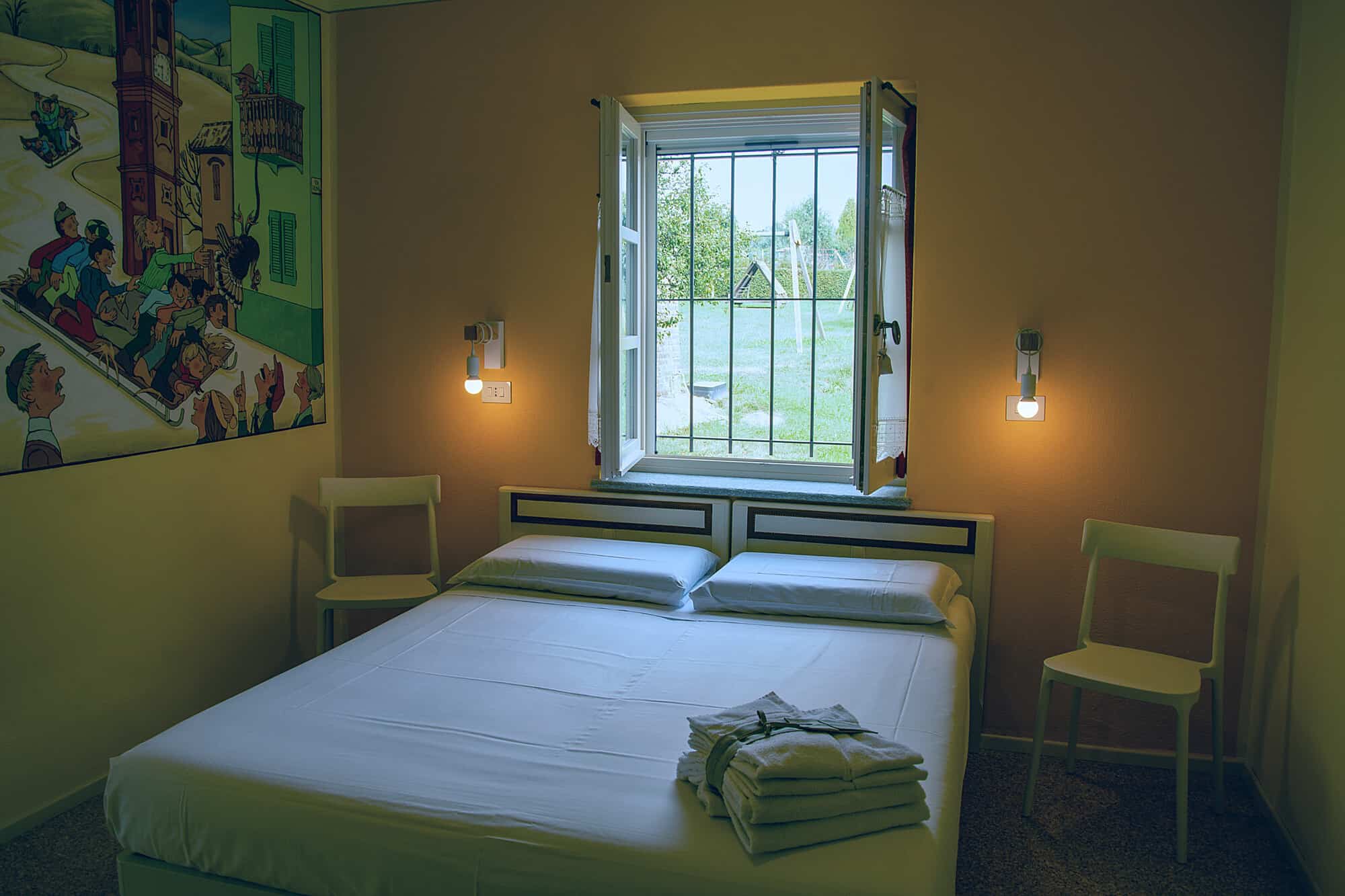
Lassie ‘ndè mòle! — and down the icy slope they went, paupers and lords alike.
The room
 2 adults 1 double bed or 2 twin beds En-suite bathroom with shower Km0 breakfast included Air conditioning Ground floor Direct access to the portico Free Wi-Fi
Underfloor heating. Electric kettle and herbal teas provided. Hairdryer. Smart TV. Window screens.


The room La Slesà in Roero is located on the ground floor of the farmhouse Cascina Ponchietta. The bed can be configured as a double 160×190 or as two twin beds 80×190. Having direct access to the portico makes this the perfect choice for those who wish to have a cozy spot outdoors with tables and benches away available.
La Slesà
The Sled Race
In winter, the sloping roads in the Roero towns became icy paths. People built makeshift sleds and held night watches, braving the icy slopes by forming human chains of up to twenty people to sled down them together. And, in all of that, there were also people trying to sabotage it all.
The harshness of winter and the abundant snowfall in Roero take us back to the time when, in our villages, the arrival of snow was a source of entertainment for children, but especially for adults. In fact, the snow would last for months and months, slowing down work activities and even the perception of time; up until the 1950s, many natural slopes in the Roero’s historic town centers were repurposed as the setting for racing competitions in the game of La Slesà.
The Slesà was nothing more than a downhill road paved with ice, which was traversed at great speed on all kinds of improvised sleds, fostering village competitions and guaranteed fun for the public. Various types of sleds were used: the “sleson”, a wooden platform with iron blades fixed at the bottom, or simple “lese,” wooden planks, often an “ass da lavé” (hand-washing laundry board) stolen from the women of the house.
Every evening, the icy slopes were meticulously prepared: people pulled water from the well to throw it over the layer of beaten snow on the road, leveling it and assuring it would freeze during the night. The inhabitants of the houses on the side of the track often resented the shouting and hollering common during the festive atmosphere of the competitions and the fact that they could not pass freely on the route, therefore they often tried to sabotage the frozen tracks by scattering ash or hot water over them; the fierce challengers thus organized nighttime vigils to make sure their playing grounds would not be harmed, often equipped with “pinton” (wine jugs) and glasses.
In the widest and most dangerous curves, banks of tuff and snow were erected, reaching up to a meter in height, where the sleson would pick up great speed without leaving the track before facing the final straight. The game of Slesà, both during daytime and in the evenings, often became a real group challenge: slesons were tied to each other to gain speed and on some occasions, participants formed human chains, intertwining legs and arms to form the so-called “barcon” (big boat).
The barcon amassed up to ten or twenty people, which would throw themselves in the race to the battle cry “lassie ‘ndè mòle!” (let them go limp!): the neighbor’s legs, in fact, served as a rudder to the human tow, so it was better if they were malleable and maneuverable. Sometimes the degree of difficulty of the game was increased with the “pitu race”: a turkey was hung halfway down the runway as a trophy to be caught (Montà), or a pole was hoisted from which hung a ring to be grabbed and caught by hand (Canale). The prize for the winners was the “pitu” (the turkey): hence the name of the competition.
A while after the tradition had stopped, the local priest Don Filippo Chiesa dedicated an ode in dialect to this entertainment, which we quote in part:
Fòrsa fieuj…andoma a la slesa, o cioché o l’ha dài set e mesa!
Da jer sèira l’oma daje fin-a scur e o travaj l’ha nen smorane sicur.
Con le spale carià de sleson a sortiva ij giovò dai porton…
“foma barcon”… e ti ‘t partìi… e d’arivè gran piasì ‘t l’avìi,
ma nen tuti j’ero fortunà, tanti i la davo per la stra.
J’ero crij, j’ero braj, gambe ‘lva. D’antorn i corivo sbaruvà
ma gnun mòrt a-i restava ‘n sa stra!
A la slesa j’era pa ‘d distinsion, tuti istess: patachin e sgnoron.
Per la slesa ch’a torna mai pì, giovo e vej… s-ciopaté ‘l man per piasì.