
During the day they were normal women. In the night, moving through the Roero hills, it was a different story.
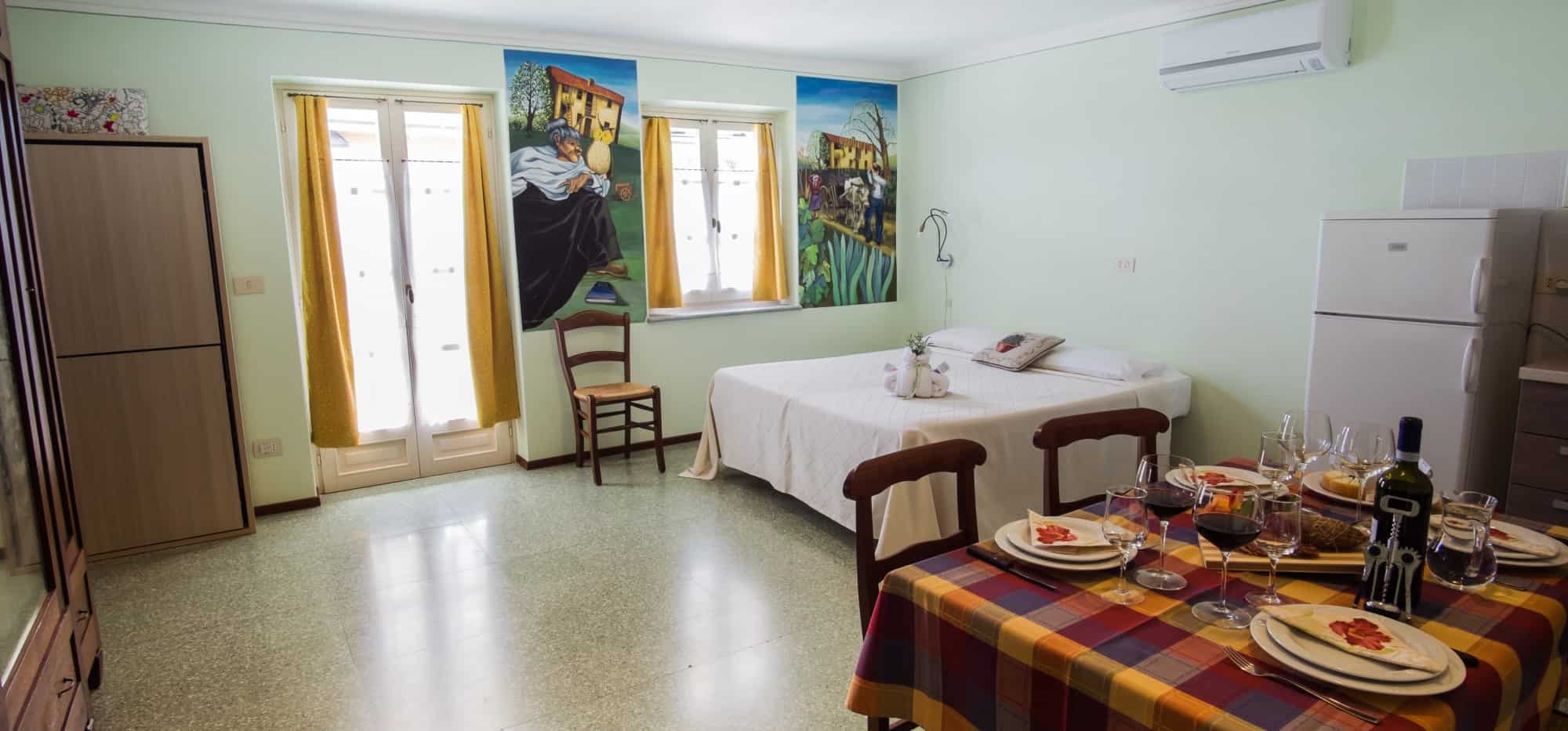
The studio apartment
 2+2 under 12 Furnished kitchen 170×190 Bunk beds Bathroom with shower First floor Free breakfast Air conditioning Free Wi-Fi Shared balcony
Minimum stay of 3 nights (7 nights in summer, Saturday to Saturday). 30 sq.m. First floor, no internal stairs. Bunk beds: 2, 80×190.
Underfloor heating. Smart TV. Window screens. Weekly cleaning included. Can be configured for 3 adults + 1 child under 12.


The studio apartment Le Masche in Roero is comfortable, with no internal stairs, and is ideal for families with small children.
From the balcony, shared with the room Cantè j’ov, the view spans the Roero countryside and the Monte Viso.
The tables and benches under the portico are available to all guests, and are perfect for outdoor dining.
Le Masche
The Witches of Roero
In the hills of Roero, as evening falls, there is a word that recurs in ancient tales: the masche, mysterious women who shapeshift at night.
In the peasant family, the long winter vigils were the perfect venue for telling tales and fables of “masche”, the witches of the Roero and Langhe area.
The name comes from the piedmontese “mascara”, mask, an object used since ancient times to represent the idea of transformation. In the Langhe and the Roero, the first mention of the “masche” dates back to 643 AD, in the Edict of Rotari: “stria quod est masca.”
In the local oral culture, the term denotes people, usually elderly women, who terrorized the inhabitants of the community with more or less serious accidents.
The masche operated in the dark, at dusk and especially at night: unbeknownst to their unaware loved ones and while their bodies were left slumbering in their bed, the spirit of the “masca” would rise from their body and transform into an animal. Once the new form was aquired, they would thrawl through the town, causing mischief and accidents: they often delighted in stopping oxen at work, overturning wagons, breaking farm tools and confusing and frightening travelers.
Sometimes they were not satisfied with such simple misbehaviour and would adopt far crueler practices, up to and including infanticide.
The source of their power was the “Book of Command”, which contained all the magical spells necessary to cast evil jinxes and curses. But along with power, the book also represented the damnation of the owner who, no matter how old and sick, was unable to die unless the book was passed down to a new adept.
The “handover” ritual was very peculiar: it was said to take place in the presence of the Devil himself, on a Friday night, necessarily at a crossroads in the vicinity of a large tree which had been struck by lightning.
The masche were feared, their actions were to be suffered in silence. Only when their evildoings were particularly grievous would the people resort to the priest or the “settimino” (the seventh male son of a family, who was born premature in the seventh month of pregnancy; they were said to have psychic powers).
The people suspected of witchcraft were often shunned by the rest of the community, and the severity of their isolation depended on the severity of the acts they were suspected of having committed.
However, the reactions of the community weren’t always non-violent: there is no shortage of accounts of reactions where maiming was inflicted on the animal in which the witch was thought to have transformed.
The recommended way to “reveal” the identity of the masca, in fact, was by cutting off the leg of a suspiciously acting black cat, or striking down a hovering bat or throwing rocks at a hooting owl; the next day, the town inhabitants would look at each other suspiciously, trying to find the person who had mysteriously lost a limb, or was sporting familiar bruises in the shape of their neighbour’s farm tools, or was walking on broken toes.
The strength of these beliefs in Montà is attested as far back as the 1500s.
In their most serious outcomes: “Ambrogio, son of Bartholomeo Moresco, of 12 years of age, died of a curse” was the cause of death recorded by the priest Claudio Spagnolo on July 5, 1625.
And in their most tragic outcomes: “Fiorina, widow of Pietro Callorio,” writes the same priest on October 25, 1628, “died the 20th in the prison cell of the castle for having been accused of being a masca.”
These beliefs even marked the local toponymy: a priest from the early 1800s named the last stretch of the ancient path from “Canale” to the Villa’s bell tower “Via delle Masche” (the road of the masche).
The fear of their presence, until not too many decades ago, forced the townsfolk to adopt many supersticious habits: taking certain precautions during pregnancy, telling children to be wary when approaching “suspect” people in the community, up to and including making sure the laundry is taken inside in the evening before the belltower rings the “Ave Maria” (signaling nightfall) so that it would not be “hexed”.